











France and Germany have struck a long-awaited governance deal over KNDS, clearing the main political obstacle to one of Europe’s most closely watched defence listings in years.
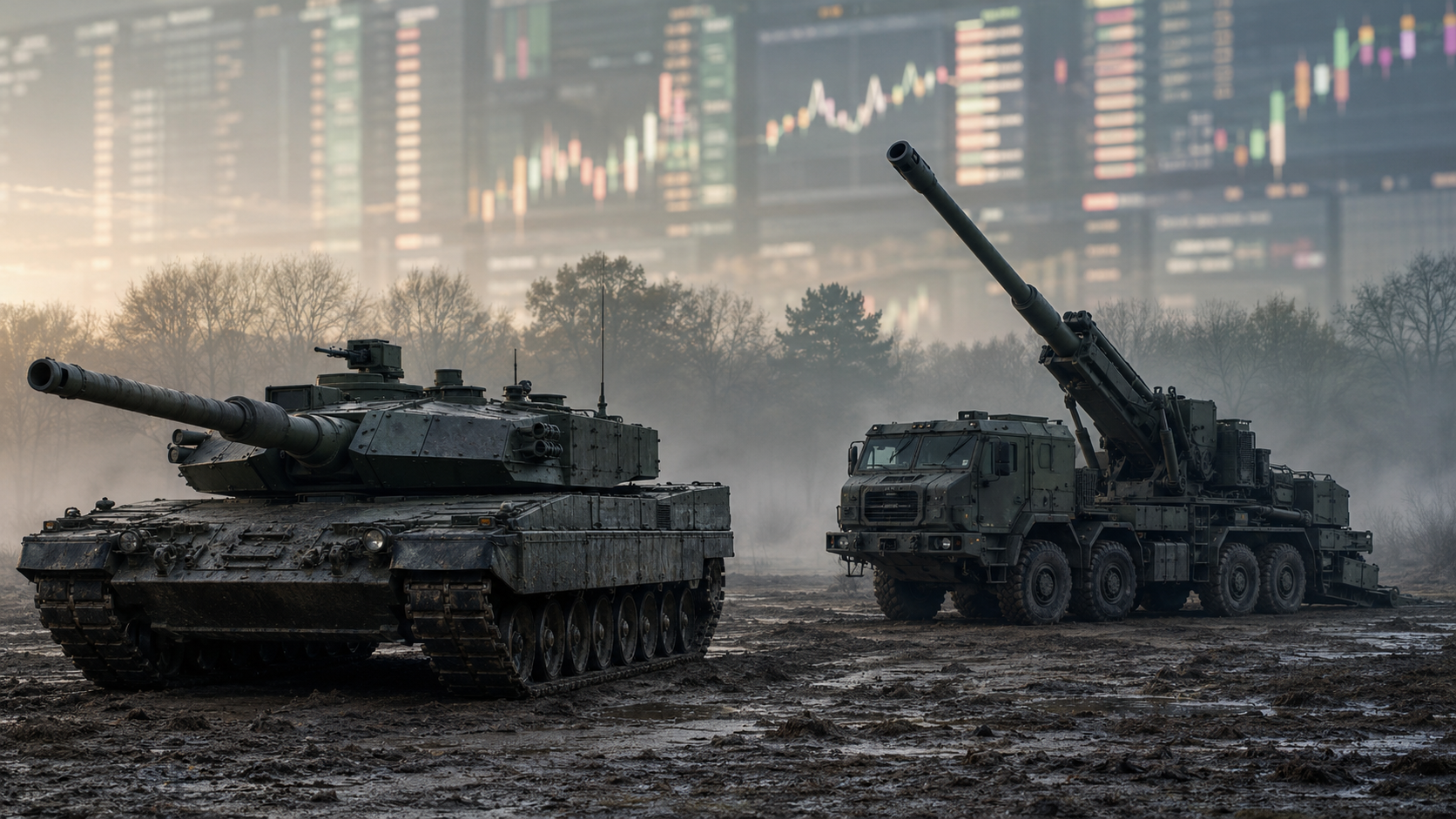
The Franco-German group, which makes the Leopard 2 tank and the Caesar howitzer, is preparing for a dual listing in Paris and Frankfurt as early as July.
The offering is expected to sell about 20% of the company to public investors, while Berlin and Paris retain large anchor stakes.
The valuation is now being pitched more cautiously than earlier hopes of a $23 billion-style defence blockbuster.
Recent guidance points to a range closer to €15bn to €18bn, reflecting both the strength of KNDS’s order book and the governance discount investors are likely to demand.
KNDS IPO: From the battlefield to the stock exchange
KNDS is not a flashy defence-tech story. It is a heavy industrial supplier of the equipment European armies actually need as they rebuild depleted arsenals after Russia’s full-scale invasion of Ukraine.
The company was created in 2015 through the merger of Germany’s Krauss-Maffei Wegmann and France’s Nexter Systems.
That combination gave Europe a dominant land-systems manufacturer, spanning main battle tanks, artillery, armoured vehicles and ammunition.
Its numbers explain why investors are paying attention. KNDS reported revenue of €4.4 billion for 2025, up around 16% from a year earlier.
Its order backlog climbed to a record €33.1 billion, equal to roughly 7.5 times annual revenue.
That is an unusual level of visibility for a heavy manufacturer. It also reflects a structural shift in European capital allocation, as defence moves from an ESG problem to a security necessity.
“Defence is a major investment thematic now,” an ECM investor told ION Analytics’ ECM Pulse EMEA in January.
A deal ten years in the making
The listing is also the end of a complicated ownership story.
Since the 2015 merger, KNDS has been split between the French state and the German Wegmann family, which controlled the former Krauss-Maffei Wegmann business.
The family’s decision to sell its stake accelerated the IPO timetable and forced Berlin to decide how much influence it wanted over a strategic defence supplier.
That debate dragged on for months. German officials argued over stake size, veto rights and price, while investors watched for signs that a public listing could be delayed or burdened by political controls.
The breakthrough came this week, when Germany agreed to take a 40% holding, broadly matching France’s position after the float.
The European Commission had already cleared the acquisition without conditions, removing another obstacle before the planned listing.
Still, the dispute has come at a cost. Market expectations have moved down from earlier valuation hopes, with banks and investors now focused on whether KNDS can be priced sensibly enough to absorb the state-ownership complexity.
“It’s mostly tanks… this isn’t Palantir,” an institutional investor told ION Analytics’ ECM Pulse EMEA in May, describing KNDS as a solid supplier to German and French military programmes rather than a speculative technology play.
That may be exactly the point. In a market still nervous about crowded defence trades, KNDS is being sold on backlog, hardware and sovereign demand rather than hype.
The post KNDS IPO: the $23 billion defence bet that could reshape Europe’s armies appeared first on Invezz