











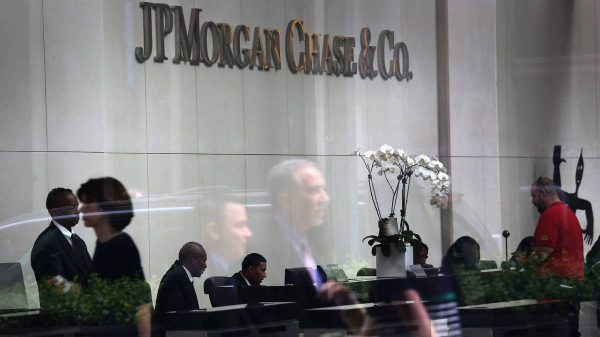






If you own J.P. Morgan Chase stock, the last two weeks delivered everything a shareholder could want.
JPMorgan cleared the Federal Reserve‘s stress test, unveiled a record $50 billion buyback, and lifted its dividend 10%, The Motley Fool reported.
None of that changes a stubborn arithmetic problem hiding behind the celebration, however. J.P. Morgan’s valuation multiples have stretched well past their historical range, and no amount of capital return can erase a price tag that may already reflect the best-case scenario.
J.P. Morgan’s forward P/E sits 27% above its five-year average
The stock’s forward price-to-earnings ratio was 14.9 times projected earnings as of late June, GuruFocus reported, while its trailing P/E of about 15.9 times is well above the five-year average of 11.7 times, according to Public.com data.
The premium extends across other yardsticks, with the price-to-sales ratio at 4.8 times against a five-year average of 3.6 times and the price-to-book ratio reaching 2.5 times compared with a historical norm of 1.8 times, as The Motley Fool noted in a July analysis.
J.P. Morgan’s stress test and earnings reinforce the bull case
The fundamental argument for owning J.P. Morgan starts with numbers that are hard to argue against, beginning with the Federal Reserve’s 2026 stress test.
The Fed modeled a severe global recession with 10% peak unemployment, a 30% drop in home prices, and a 39% drop in commercial real estate prices.
JPMorgan entered the scenario with a common equity tier 1 capital ratio of 14.6%, comfortably above the 11.5% regulatory minimum and in line with the 14.3% ratio reported as of March 31, 2026, the company’s SEC filing confirmed.
More Bank stock resets:
- Bank of America resets Nvidia stock forecast after CFO meeting
- JPMorgan resets FedEx stock rating ahead of June spinoff
- Bank of America resets AMD stock price target
“Our fortress balance sheet, with significant excess capital and robust liquidity, enables us to be a pillar of strength, allowing us to consistently serve our clients and communities,” CEO Jamie Dimon said in the filing.
First-quarter 2026 results reinforced the message, as the bank reported $5.94 in diluted earnings per share, a 17% increase from a year earlier, on managed revenue of $50.5 billion that rose 10% year over year, J.P. Morgan disclosed in its earnings presentation.
John Moore/Getty Images
J.P. Morgan’s $50 billion buyback has a valuation caveat
Within hours of the stress test, J.P. Morgan’s board raised the quarterly common dividend to $1.65 from $1.50 and authorized up to $50 billion in stock repurchases starting July 1.
The buyback ranks among the largest single authorizations in banking history, signaling that management views the capital cushion as substantial enough to return aggressively to shareholders.
Buybacks at elevated valuations, however, create tension because the bank is repurchasing shares at prices well above historical norms relative to earnings and book value.
Simply Wall St’s analysis also noted that the repurchase program does not eliminate key risks related to mounting regulatory and capital demands that could restrict how flexibly J.P. Morgan deploys its balance sheet.
J.P. Morgan insiders sold $67 million in stock during the rally
J.P. Morgan insiders sold approximately $67.3 million in shares over three months ending in mid-2026, with zero insider purchases during that stretch, GuruFocus reported.
Dimon himself sold 130,488 shares in April, generating proceeds of about $40 million, a TipRanks analysis of SEC filings confirmed.
He tied the dividend hike to strong performance and readiness for stress testing, CNBC noted.
The Board’s intended dividend increase is supported by our consistent investment in our business and strong financial performance.
“As always, we are prepared for a wide range of scenarios, including the hypothetical 2026 supervisory severely adverse scenario,” Dimon added.
Executives sell for tax planning, estate management, and diversification reasons, but the pattern is more notable when it coincides with multiples in the top quartile of their historical range.
Analysts rate J.P. Morgan a buy, but price targets leave thin upside
Wall Street‘s consensus remains a buy, with 13 analysts covering the stock and an average price target of $346.54 as of early July, Public.com data indicated.
Evercore ISI maintained its outperform rating with a $340 target in April, while Jefferies held a more cautious hold rating at $320, Benzinga reported.
With shares already trading near $335, the average target implies roughly 3% upside, a thin margin that shows how much of the bull case the market has absorbed.
J.P. Morgan’s next earnings report lands July 14, with analysts expecting $5.61 in earnings per share on $49.56 billion in revenue, Benzinga noted.
How J.P. Morgan’s premium price shapes the investment calculus
J.P. Morgan has earned its standing as the dominant franchise in American banking, with $4.9 trillion in total assets and a return on tangible common equity of 23% in the first quarter, according to the company’s Q1 2026 earnings presentation, and operations spanning 66 countries, GuruFocus reported.
Analysts covering the stock have flagged the disconnect between operating strength and valuation.
Motley Fool contributor Reuben Gregg Brewer argued in a July analysis that the 27% to 39% premium above historical valuation averages leaves a limited margin of safety in a cyclical industry, where the next downturn could compress those multiples toward their long-term means.
Brewer added that a recession or sustained downturn could offer patient investors a more attractive entry point, given that J.P. Morgan‘s own stress test showed it can absorb severe shocks while maintaining capital well above regulatory floors.
Related: J.P. Morgan names stock sectors primed for serious growth