

















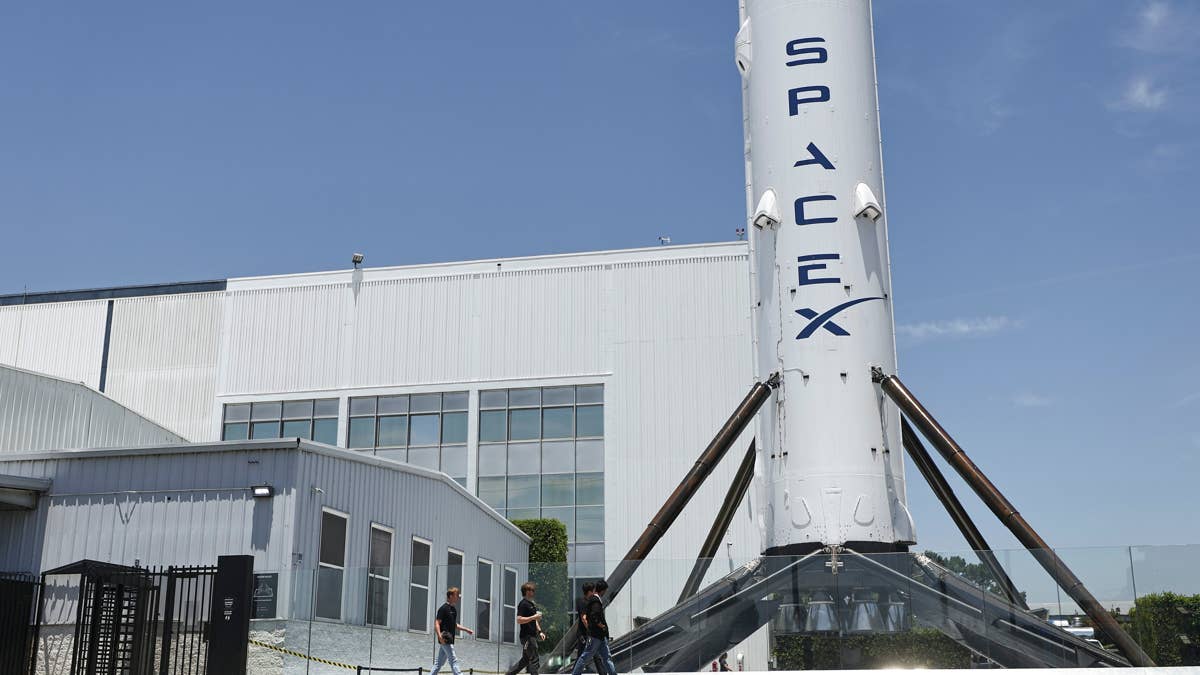
SpaceX began trading on the Nasdaq on June 12, 2026, under the ticker SPCX, raising $75 billion at a $1.75 trillion valuation in the largest IPO ever.
Two days earlier, Franklin Templeton CEO Jenny Johnson sat down with CNBC‘s “Squawk Box” and described SpaceX as reflecting “the greatest technological change of my lifetime.”
That comment, made just ahead of one of the most anticipated debuts in market history, captures the central tension now facing investors.
SpaceX is not simply going public as a rocket company. It is going public as three businesses bundled into one, and the company’s own prospectus is unusually direct about how differently those three businesses are performing.
What SpaceX’s own filing says about its three segments
SpaceX’s S-1 registration statement, filed with the SEC, breaks the company into three segments: Space, Connectivity, and AI. For the first quarter of 2026, SpaceX reported consolidated revenue of $4.69 billion and a loss from operations of $1.94 billion.
For the full year 2025, consolidated revenue was $18.67 billion against a loss from operations of $2.59 billion.
The segment breakdown explains why those headline numbers move in different directions depending on which part of the business is included. Space generated $619 million in revenue but lost $662 million on an operating basis, largely because the segment funded $930 million in Starship research and development during the quarter.
Connectivity, primarily Starlink, generated $3.26 billion in Q1 2026 revenue and $1.19 billion in operating income.
The AI segment, which includes xAI following its February 2026 merger into SpaceX, generated $818 million in revenue and lost $2.47 billion from operations in the same quarter.
Connectivity segment is carrying SpaceX, while AI burns cash
The pattern is consistent across both the quarter and the full year. In 2025, Connectivity generated $11.39 billion in revenue and $4.42 billion in operating income, up 49.8% and 120.4% year-over-year respectively. The AI segment generated $3.2 billion in revenue but lost $6.36 billion from operations across the same year.
For investors, the practical reading of the prospectus is straightforward. Starlink’s growth and margin expansion are funding the company’s ability to absorb enormous losses in the AI segment while that business scales.
More Wall Street:
- JPMorgan resets S&P 500 price target for the rest of 2026
- Vanguard challenges the S&P 500 as a one-stop strategy
- Goldman Sachs resets Broadcom stock forecast
The subscriber numbers explain why Connectivity carries that weight. SpaceX reported approximately 10.3 million Starlink subscribers as of March 31, 2026, served by a constellation of roughly 9,600 satellites across 164 countries and territories, according to the S-1 filing.
SpaceX’s capital expenditures make the scale of the AI bet explicit by comparison: The AI segment’s 2025 capital expenditures were $12.73 billion, more than the Space and Connectivity segments combined.
The AI compute contracts Wall Street is watching
The AI segment’s losses are the most visible risk in the prospectus, but SpaceX’s filing also discloses the contracts it is using to offset them. In May 2026, SpaceX entered into cloud services agreements with Anthropic for access to compute capacity across its COLOSSUS and COLOSSUS II data centers, with Anthropic agreeing to pay $1.25 billion per month through May 2029, according to the S-1 filing.
SpaceX also disclosed a separate arrangement with Cursor, the AI coding company, structured as a compute agreement paired with an option to acquire Cursor at an implied equity value of $60 billion, payable in SpaceX stock.
If SpaceX does not exercise that option, Cursor is entitled to a $1.5 billion termination fee plus an $8.5 billion deferred services fee. The structure signals how SpaceX intends to monetize excess AI compute capacity, sometimes through service contracts and sometimes through equity-linked arrangements with the AI companies it serves.
Yanow/Getty Images
The launch business behind everything else
The Space segment’s operating loss can be misleading if read in isolation, because it is the segment funding Starship development rather than a sign of an unprofitable launch business.
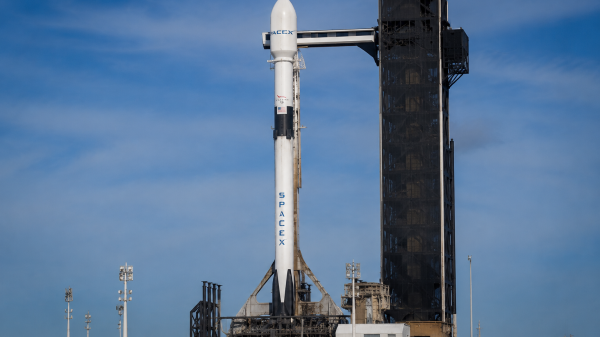
SpaceX has completed approximately 650 orbital launches as of March 31, 2026, with a mission success rate above 99% across its Falcon 9 and Falcon Heavy rockets, according to the S-1 filing. The company describes itself as the primary launch provider for the U.S. government, having launched 11 of 12 National Security Space Launch missions in 2025.
That launch infrastructure is also the foundation for the other two segments. Starlink satellites reach orbit on Falcon rockets, and the company’s prospectus frames Starship, still in development, as the vehicle that will eventually carry both next-generation Starlink satellites and the AI compute satellites SpaceX says it plans to deploy starting as early as 2028.
The Space segment’s losses today are, in the company’s own framing, the cost of building the launch capacity the other two segments will depend on later.
Why Franklin Templeton’s framing matters for SpaceX valuation
Johnson’s description of SpaceX as reflecting the greatest technological change of her lifetime is notable because Franklin Templeton manages more than $1.5 trillion in assets and has built out significant exposure to tokenized funds and alternative assets in recent years.
When an executive at that scale frames a single company in those terms two days before its public debut, it signals how institutional allocators are thinking about where SpaceX fits in a portfolio.
The framing also lines up with how SpaceX describes its own opportunity. The company’s prospectus estimates a combined total addressable market of $28.5 trillion across its three segments: $370 billion in Space, $1.6 trillion in Connectivity, and $26.5 trillion in AI.
Within the AI figure, SpaceX breaks the opportunity down further into $2.4 trillion in AI infrastructure, $760 billion in consumer subscriptions, $600 billion in digital advertising, and $22.7 trillion in enterprise applications, by far the largest single category in the entire addressable market the company has laid out. The Connectivity TAM splits into $870 billion in Starlink Broadband and $740 billion in Starlink Mobile.
The first trading session will not resolve the debate over whether that $1.75 trillion valuation is justified. What the prospectus does confirm is that the bet is not on SpaceX as a single business.
It is a bet that Connectivity’s current profitability can fund the AI segment’s losses long enough for compute contracts like the Anthropic deal to scale, while the Space segment’s Starship investment eventually unlocks the next phase of growth that Johnson’s comments were pointing toward.
Related: Morningstar drops bombshell message on SpaceX IPO